
A queue holds inbound callers in a virtual line and offers each call to your team by rules you set: who rings, in what order, for how long. Reach for one when more callers can arrive than there are people free to answer.
Overview
Use a queue when more callers can arrive than people are free to answer. Calls usually enter a queue from a call flow's Enter queue step. The settings here are stored configuration: the actual ringing, timing, and routing happen on the telephony platform at call time.
Membership is the union of five pickers (Users, Pickup lines, Groups, Pools, Statuses). Statuses is the exception: it filters the other sources rather than adding members of its own.
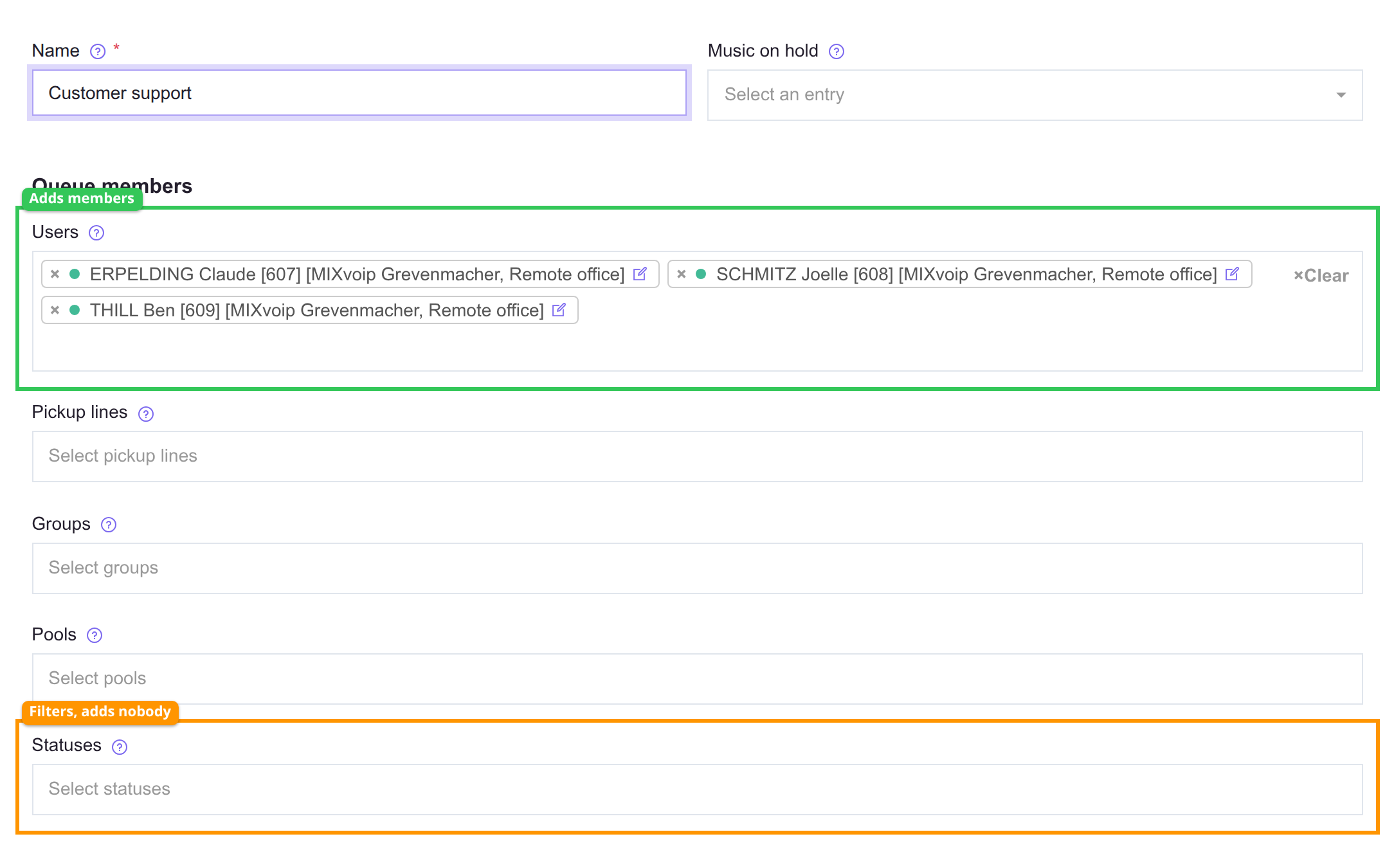
| Outline | Picker | What it does |
|---|---|---|
| Green | Users, Pickup lines, Groups, Pools | Each one adds members. |
| Orange | Statuses | Filters the pickers above. On its own it adds nobody. |
What you configure
The ring strategy is a choice you set, and the platform decides who rings based on it:
| Strategy | Intent |
|---|---|
| Ring all | Offer the call to every available member at once. Best for small teams. |
| Round robin | Offer to members one at a time, cycling in order. |
| Fewest calls | Favor the member who has answered the fewest calls. Balances workload. |
| Least recent | Favor whoever has been idle longest. |
| Random | Pick an available member at random. |
How to stand up a queue
- Decide how members are selected. Users for a fixed list, Groups or Pools when the roster should track the team as it changes. The pickers add together, with one exception: Statuses filters the others rather than adding anybody, so a queue with only Statuses set has no members at all.
- Create the queue, add the members, and pick a ring strategy from the table above.
- Set the fallback call flow before you finish. Timeouts, the exit key, and an empty queue all send the caller there, and without one those callers have nowhere to go.
- Set the ring duration and retry delay, then decide whether an empty queue holds calls (Ring empty queue on) or drops them to the fallback immediately.
- Route calls in by adding an Enter queue step to the call flow that answers the number.
- Test it twice: once staffed, and once with every member unavailable. The second test is the one that exercises the fallback, and the one people otherwise discover in production.
See also
- Call flows - route incoming calls into a queue via an Enter queue step, and handle calls that exit it.
- Groups and Pools - the dynamic member-list sources.
- Music on hold - the audio callers hear while waiting.
- Pickup lines - shared line appearances that can be queue members.